Oregon PDF Docs

Oregon PDF Docs

Homepage ➼ Free Oregon 10 Form

Free Oregon 10 Form

Make My Document Online
Content Overview

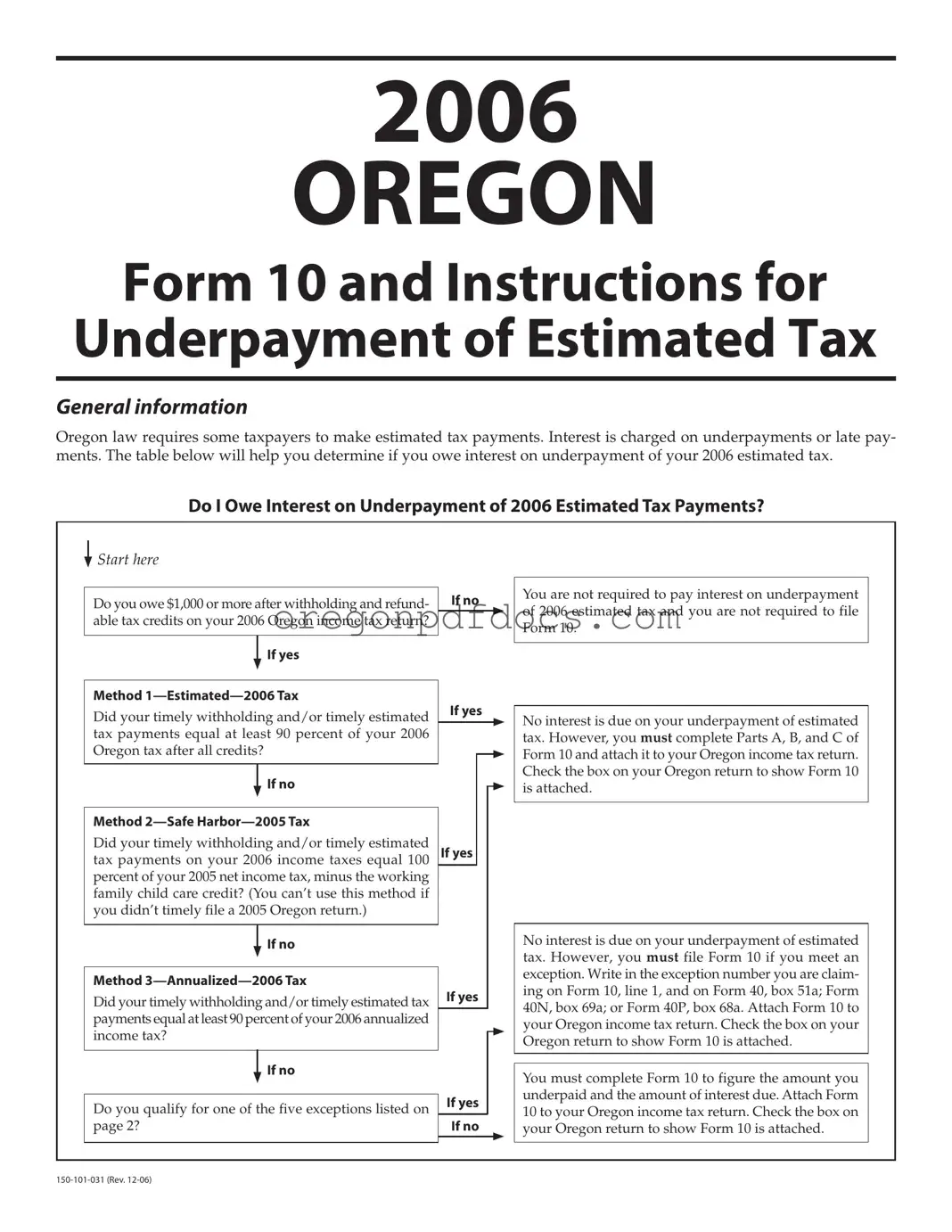
The Oregon 10 form is an essential document for taxpayers who may face penalties due to underpayment of estimated taxes. In Oregon, taxpayers are required to make estimated tax payments if they owe $1,000 or more after accounting for withholding and tax credits. The form provides methods to determine whether interest is owed on underpayments. Taxpayers can utilize three primary methods: the Estimated Method, which assesses if timely payments meet at least 90% of the current year's tax; the Safe Harbor Method, which allows payments equal to 100% of the previous year's tax; and the Annualized Method, which considers income fluctuations throughout the year. Additionally, the form outlines five exceptions where taxpayers may not owe interest, such as for farmers, those with prior year tax liabilities of zero, or individuals facing unusual circumstances. Completing the Oregon 10 form accurately is crucial, as it helps calculate any interest due and ensures compliance with state tax laws. Attach the completed form to your Oregon income tax return to avoid potential penalties.

Similar forms

  • IRS Form 2210: This form is used by taxpayers to calculate penalties for underpayment of estimated tax. Like the Oregon 10 form, it helps determine if you owe interest on underpayments. Both forms require you to assess your tax situation based on your income and payments made throughout the year.
  • California Form 5805: Similar to the Oregon 10 form, this document is used to calculate underpayment penalties in California. It includes methods to determine if estimated payments met required thresholds, similar to the Oregon form's methods for calculating underpayment interest.
  • New York Form IT-2105: This form is for New York residents to report and calculate estimated tax payments. It shares similarities with the Oregon 10 form in that both require taxpayers to evaluate their estimated payments against their tax liability to avoid penalties.
  • Notice to Quit Form: Essential for landlords in Georgia, this form can be crucial for ensuring proper eviction procedures. Understanding the implications of using the Forms Georgia is vital for both landlords and tenants to navigate the eviction process effectively.

  • Federal Form 1040-ES: This form is used for estimating taxes owed for the upcoming year. Like the Oregon 10 form, it requires taxpayers to project income and calculate the necessary payments. Both forms emphasize the importance of timely payments to avoid interest and penalties.

Key takeaways

  • Oregon law mandates certain taxpayers to make estimated tax payments.
  • Interest may be charged on any underpayments or late payments.
  • To determine if interest is owed, assess your 2006 tax return for a balance due of $1,000 or more after withholding and credits.
  • Three methods exist to avoid interest on underpayment: estimated payments equal to 90% of your current tax, 100% of the previous year's tax, or annualized income calculations.
  • If you meet specific exceptions, you may not need to pay interest or file Form 10.
  • Exceptions include being a farmer or commercial fisherman, having a prior year tax of zero, or experiencing unusual circumstances like natural disasters.
  • Complete Parts A, B, and C of Form 10 to calculate underpayment amounts and any interest due.
  • Attach Form 10 to your Oregon income tax return and check the appropriate box to indicate it is included.
  • Keep in mind that underpayment interest accrues until the balance is paid in full or until April 16 of the following year.
  • Accurate record-keeping of payments and dates is essential for calculating interest correctly.

File Details

Fact Name Details
Purpose The Oregon 10 Form is used to calculate underpayment of estimated tax for the year 2006.
Governing Law This form is governed by Oregon Revised Statutes (ORS) 316.573 and 316.587.
Estimated Payments Requirement Taxpayers may need to make estimated tax payments if they owe $1,000 or more after withholding and credits.
Interest on Underpayments Interest is charged on any underpayments or late payments made on estimated tax.
Methods of Calculation Three methods exist to determine if underpayment interest is owed: Estimated Tax Method, Safe Harbor Method, and Annualized Income Method.
Exceptions Five exceptions allow taxpayers to avoid underpayment interest, including those related to farming income and prior year tax situations.
Form Attachment If you owe interest, you must complete and attach Form 10 to your Oregon income tax return.
Filing Deadline Form 10 must be filed with your 2006 Oregon individual income tax return by the due date of the return.
Interest Calculation Interest is calculated on the running balance of tax due from specific payment dates until the balance is paid or until April 16, 2007.
Contact Information For questions about exceptions, taxpayers should contact the Oregon Department of Revenue.

Documents used along the form

The Oregon 10 form is an essential document for taxpayers who need to report underpayment of estimated taxes. Along with this form, several other documents are often required to ensure compliance with Oregon tax regulations. Here’s a brief overview of these additional forms and documents.

  • Form 40: This is the standard individual income tax return for Oregon residents. It reports income, deductions, and credits to determine tax liability.
  • Form 40N: This form is for non-residents of Oregon. It helps calculate income tax based on income earned within the state.
  • Form 40P: This is for part-year residents of Oregon. It allows individuals who moved in or out of the state during the year to report their income and tax obligations accurately.
  • Form 41: Used by corporations, this form reports corporate income tax. It is relevant for S corporations that may have shareholders needing to file Form 10.
  • Form 4797: This form is used to report the sale of business property. It may be relevant for farmers or fishermen claiming exceptions on the Oregon 10 form.
  • Schedule F: This is a supplemental form for reporting farm income and expenses. It helps farmers determine their gross income for tax purposes.
  • Schedule C: This form is for sole proprietors to report income and expenses from their business. It is crucial for those claiming exceptions under the Oregon 10 form.
  • Form 8879: This is an IRS e-file signature authorization form. It allows taxpayers to electronically sign their returns, including state forms.
  • Pennsylvania Promissory Note: This legal document is essential for formalizing a debt agreement and can be tailored to your specific needs. For further details, you can find a suitable template here: https://promissoryform.com/blank-pennsylvania-promissory-note.
  • Form 150-101-031: This is the instruction document for the Oregon 10 form. It provides detailed guidance on how to complete the form correctly.
  • Form 40V: This is the payment voucher for Oregon income tax. It is used when making payments with the tax return or for estimated tax payments.

Each of these forms plays a vital role in ensuring that taxpayers comply with Oregon tax laws. Understanding their purpose can help streamline the filing process and avoid potential penalties.