Oregon PDF Docs

Oregon PDF Docs

Homepage ➼ Free Oregon Monthly Mileage Tax Form

Free Oregon Monthly Mileage Tax Form

Make My Document Online
Content Overview

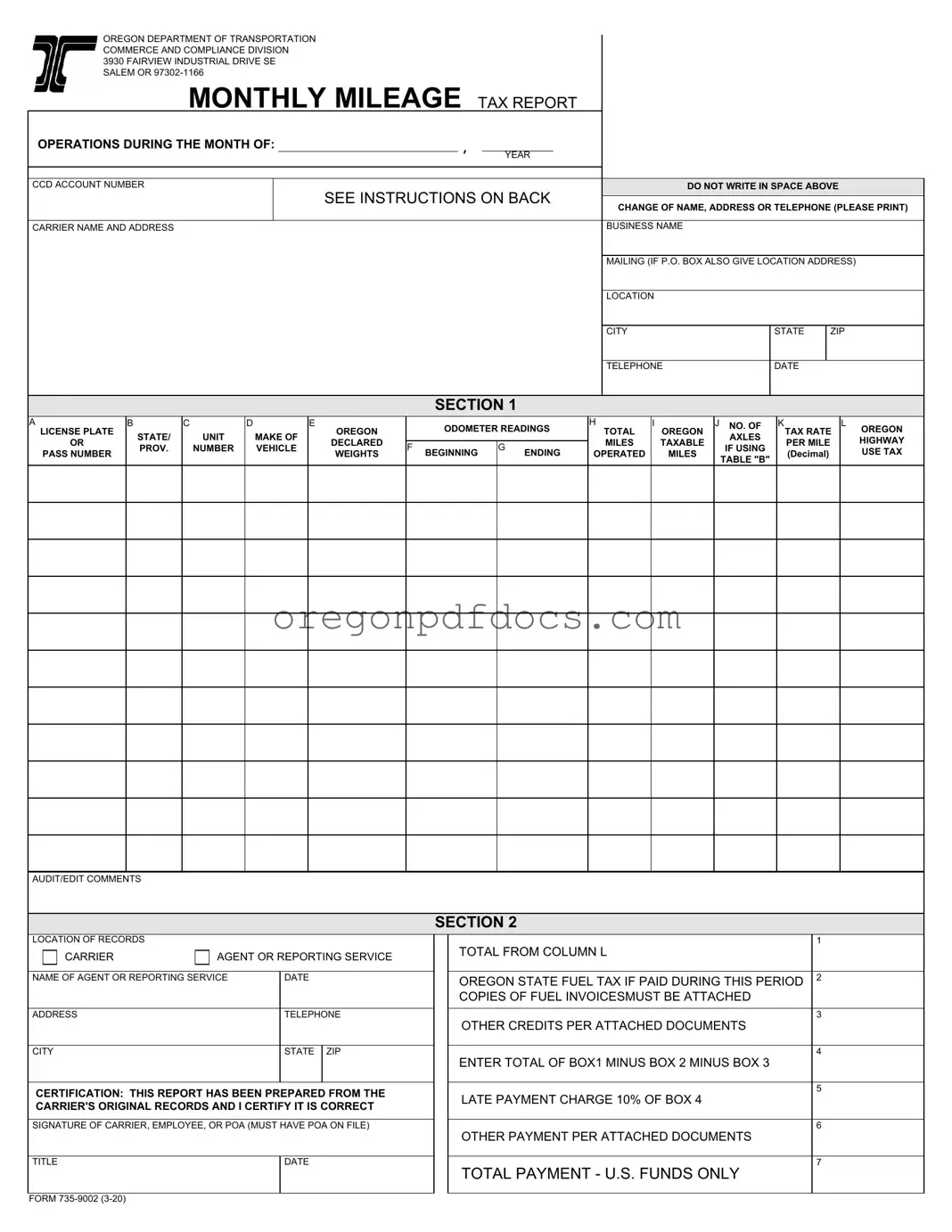
The Oregon Monthly Mileage Tax form is an essential document for trucking companies and operators who utilize vehicles registered in the state. This form is required to report the mileage traveled on Oregon public roads and to calculate the corresponding highway use tax. Each month, businesses must accurately detail their vehicle operations, including the beginning and ending odometer readings, the total miles operated, and the taxable miles driven in Oregon. The form includes specific sections for entering information about each vehicle, such as the license plate number, state of registration, and the vehicle's make and declared weights. Additionally, it outlines the tax rates applicable based on the weight of the vehicle, which can vary depending on whether the vehicle is loaded or empty. Alongside the mileage report, operators must also account for any Oregon state fuel taxes paid during the reporting period and provide necessary documentation to support their claims. Timely submission is crucial; reports and payments must be postmarked by the last day of the month following the reporting period. Failure to comply may result in penalties, including late payment charges. This form not only facilitates compliance with state regulations but also ensures that the necessary taxes are collected to maintain Oregon's roadways.

Similar forms

The Oregon Monthly Mileage Tax form has similarities with various other documents used in transportation and tax reporting. Each of these documents serves a unique purpose but shares common elements related to mileage reporting, vehicle identification, and tax calculations. Below is a detailed comparison of the Oregon Monthly Mileage Tax form with other relevant documents.

  • IRS Form 2290: This form is used for reporting heavy vehicle use tax. Like the Oregon form, it requires information about the vehicle, including its weight and identification details. Both forms necessitate accurate reporting of miles driven to calculate the appropriate tax owed.
  • California Highway Use Tax Report: Similar in function, this report requires vehicle operators to document mileage and weight. Both forms aim to assess taxes based on road usage, emphasizing the importance of maintaining accurate records to support reported figures.
  • New York State Highway Use Tax Return: This document is used for reporting highway use tax in New York. It shares the requirement of detailing miles traveled and vehicle specifications, making it essential for compliance with state tax regulations.
  • International Fuel Tax Agreement (IFTA) Quarterly Fuel Tax Report: This report focuses on fuel usage across state lines. Like the Oregon form, it requires detailed records of miles driven and fuel purchased, ensuring that taxes are appropriately allocated based on travel and fuel consumption.
  • New Jersey Promissory Note - This important document formalizes a borrower's commitment to repay a loan with specified terms. For an easy way to create this document, visit https://promissoryform.com/blank-new-jersey-promissory-note.
  • Texas Motor Carrier Registration Application: This application includes sections for vehicle information and operational details. Similar to the Oregon Monthly Mileage Tax form, it requires accurate vehicle identification and operational reporting to comply with state regulations.
  • Montana Vehicle Mileage Tax Report: This report is akin to the Oregon form in that it calculates taxes based on mileage. Both documents require detailed odometer readings and vehicle specifications to ensure accurate tax assessments.
  • Florida Heavy Vehicle Use Tax Return: This form is utilized for reporting heavy vehicle use tax in Florida. It shares similarities with the Oregon form, particularly in the need for accurate mileage reporting and vehicle identification to determine tax liabilities.
  • Illinois Vehicle Use Tax Return: This return is required for vehicles operating in Illinois. Like the Oregon Monthly Mileage Tax form, it necessitates the reporting of vehicle details and usage to calculate the corresponding tax owed.
  • Virginia Highway Use Tax Report: This report serves a similar purpose in Virginia, requiring detailed mileage and vehicle information. Both documents emphasize the importance of accurate reporting for compliance with state tax laws.

Each of these documents plays a crucial role in ensuring that vehicle operators comply with state tax regulations. The common thread among them is the necessity for detailed record-keeping and accurate reporting of mileage and vehicle specifications, which ultimately helps to determine the appropriate tax obligations.
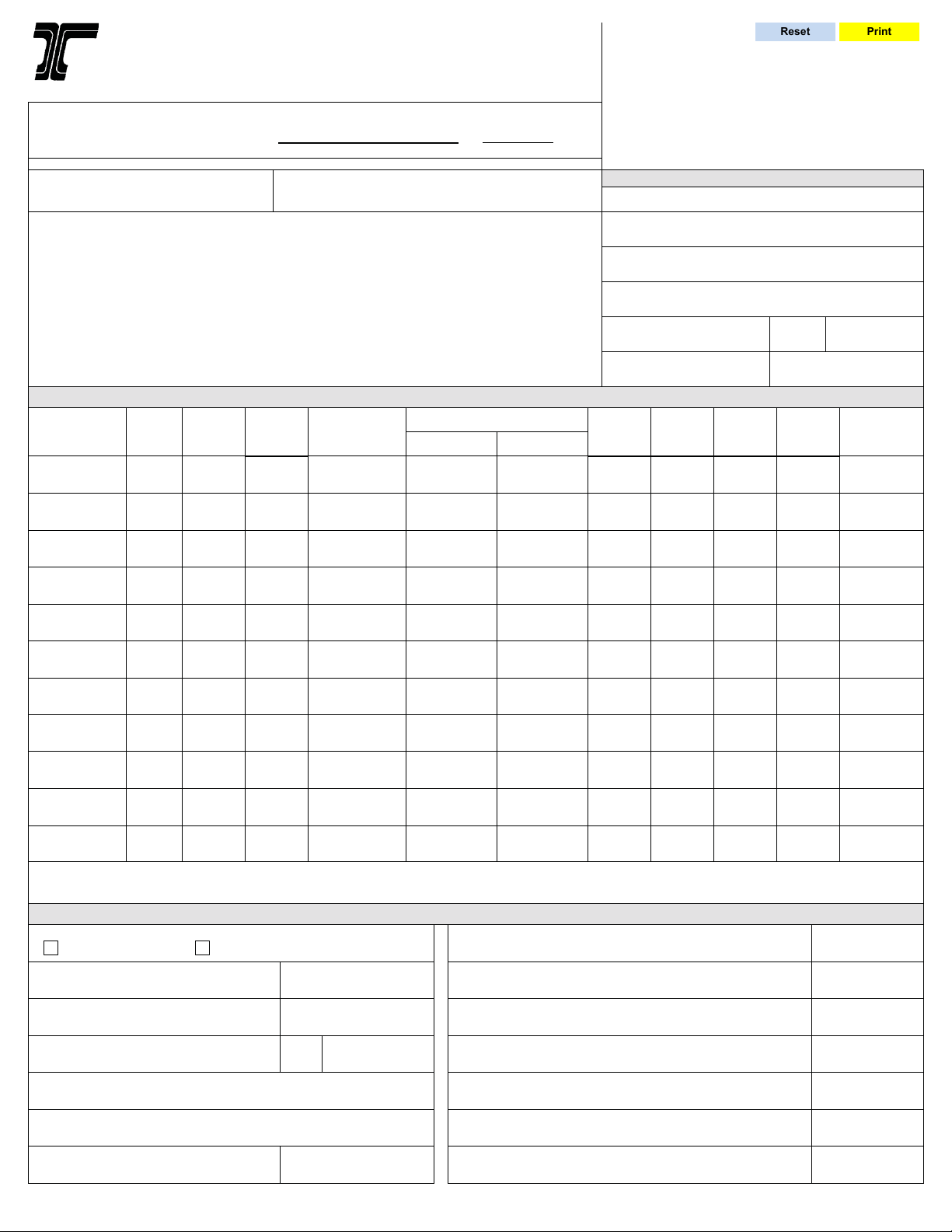
Preview - Oregon Monthly Mileage Tax Form

Form 735-9002 (6-26)
OREGON DEPARTMENT OF TRANSPORTATION
COMMERCE AND COMPLIANCE DIVISION
455 AIRPORT ROAD SE BUILDING A
SALEM OR 97301
Monthly Mileage Tax Report
Reset Print
OPERATIONS DURING THE MONTH OF:
,
YEAR
OREGON ACCOUNT NUMBER
See Instructions On Back
DO NOT WRITE IN SPACE ABOVE
CHANGE OF NAME, ADDRESS OR TELEPHONE (PLEASE PRINT)
CARRIER NAME AND ADDRESS
BUSINESS NAME
MAILING (IF P.O. BOX ALSO GIVE LOCATION ADDRESS)
LOCATION
CITY
STATE
TELEPHONE
DATE
SECTION 1
A
LICENSE PLATE
OR
PASS NUMBER
B
STATE/
PROV.
C
UNIT
NUMBER
D
MAKE OF
VEHICLE
E
OREGON
DECLARED
WEIGHTS
ODOMETER READINGS
H
TOTAL
MILES
OPERATED
I
OREGON
TAXABLE
MILES
J
NO. OF
AXLES
IF USING
TABLE "B"
K
TAX RATE
PER MILE
(Decimal)
L
OREGON
HIGHWAY
USE TAX
F
BEGINNING
G
ENDING
AUDIT/EDIT COMMENTS
SECTION 2
LOCATION OF RECORDS
CARRIER AGENT OR REPORTING SERVICE
TOTAL FROM COLUMN L
1
NAME OF AGENT OR REPORTING SERVICE
DATE
OREGON STATE FUEL TAX IF PAID DURING THIS PERIOD
COPIES OF FUEL INVOICES MUST BE ATTACHED
2
ADDRESS
TELEPHONE
OTHER CREDITS PER ATTACHED DOCUMENTS
3
CITY
STATE
ZIP
ENTER TOTAL OF BOX1 MINUS BOX 2 MINUS BOX 3
4
CERTIFICATION: THIS REPORT HAS BEEN PREPARED FROM THE
CARRIER'S ORIGINAL RECORDS AND I CERTIFY IT IS CORRECT.
LATE PAYMENT CHARGE 10% OF BOX 4
5
SIGNATURE OF CARRIER, EMPLOYEE, OR POA (MUST HAVE POA ON FILE)
OTHER PAYMENT PER ATTACHED DOCUMENTS
6
TITLE
DATE
TOTAL PAYMENT - U.S. FUNDS ONLY
7
Reset
Print
Form 735-9002 (6-26)
General Reporting Information for the Monthly Mileage Tax Report
To pay fees associated with oversize movement or Road Use Assessment Fees (RUAF) go to the Oregon Routing Information Online (ORION) website at
https://www.oregonorion.com/ or contact CCD ORION Support at CCDORIONSupport@odot.oregon.gov. Do not include RUAF on this form.
DUE DATE: Your report and payment must be postmarked by the Postal Service by the last day of the month following the end of the calendar month. An
illegible or unreadable report will be returned and considered unfiled in accordance with OAR 740-055-0010. If you file your report late, add a 10 percent late
payment charge in Box 5.
ODOT requires you to file reports and pay for all operations within the reporting period, as long as you have ODOT plates and/or vehicle(s) enrolled in the Oregon
Weight-Mile Tax Program. If there is no tax due, you must still file a report. If you did not operate a vehicle, put a zero (0) in columns I and L. If you will not be
using your vehicle(s), turn in the ODOT plate(s) or cancel by written notification.
Enter the OREGON ACCOUNT NUMBER. Enter the NAME AND ADDRESS OF THE BUSINESS as filed with Oregon Department of Transportation, Commerce
and Compliance Division (CCD).
Step-By-Step Instructions (Section 1)
Column A = Enter the plate or pass number of the power unit for which you are reporting.
Column B = Enter the state or province that issued the license plate.
Column C = Enter the company's unit number for the power unit for which you are reporting.
Column D = Enter the make of the vehicle.
Column E = You must declare and report operations at the heaviest weight operated per configuration. This should be one of the weights you declared with
ODOT. If returning empty, use the same declared weight and tax rate as when loaded.
Column F = Enter the beginning odometer reading from the first day of the month for which you are reporting. This should be the same as the ending odometer
reading from the preceding month.
Column G = Enter the ending odometer reading from the last day of the month for which you are reporting.
Column H = Enter the total miles operated for each vehicle (Column G minus Column F).
Column I = Enter the Oregon taxable miles (miles operated on Oregon public roads).
Column J = Enter the number of axles for any declared weight greater than 80,000 pounds.
Column K = Enter the appropriate rate as indicated on Form 735-9928, " Mileage Tax Rates". If you are operating between 26,001 and 80,000 pounds, use
Table A rates. If returning empty, use the same declared weight and tax rate as when loaded. Empty operations associated with Special
Transportation Permits (STP) are to be reported at 80,000 pounds. If you are operating between 80,001 and 105,000 pounds under an extended
weight permit complete all columns. Use Table B Tax Rates. Raising a lift axle is not a change in configuration and does not constitute a change in
rate. Do not use Table B rates for heavy haul operations conducted under STP when in excess of 98,000 pounds.
Column L = Compute and enter the Oregon Highway Use Tax (Column I times Column K).
Payment Instructions (Section 2)
Box 1
=
Enter the total fees from Column L.
Box 2 = Enter Oregon state fuel tax paid during this month. You may claim a credit if you pay Oregon state fuel tax on fuel purchases. Fuel must have been
purchased in the same report month credit is claimed. Attach copies of fuel invoices to the report. The invoice must contain:
Date of purchase
Name & Location of supplier
Type of fuel
Number of gallons
ODOT plate or Pass No
Amount of Oregon state fuel tax paid
If you buy fuel in bulk, you can only claim credit for fuel pumped into a qualified vehicle during the reporting period. In addition to the invoice, you
must attach records to show the amount of fuel pumped into each qualified vehicle.
Box 3
=
Box 4
=
Enter the amount of other credits as indicated on monthly Statement of Account and attach a copy. Do not use credits that have not yet appeared on
the monthly Statement of Account.
Enter the total of the amounts in Box 1 minus Box 2 minus Box 3.
Box 5
=
If you file your report late, enter 10% of Box 4.
Box 6 = Add other payments and attach the supporting documents. Payments received without supporting documentation may not be correctly applied to
your account.
Box 7
=
Enter the total of the amounts in Box 4 plus Box 5 plus Box 6.
Signature: An authorized company representative or agent must sign the report. An agent must have Power of Attorney on file with CCD before they are an
authorized representative.
Total Payment: Be sure to enclose the payment. Make checks payable to ODOT/CCD. Make a copy for your records and mail the original to: ODOT Commerce
and Compliance Division, 455 Airport Road SE, Building A, Salem, Oregon 97301. Reports are not considered filed until we receive your complete report and
payment. You are required to maintain records for three years to support the information contained in this report and forms are available for this purpose.
Our Oregon Trucking Online website is available for your convenience in filing and paying reports online. You may also amend your vehicle information using
Oregon Trucking Online. For additional record keeping requirements and tax reporting information, contact CCDTaxAssistance@odot.oregon.gov or call 503-378-
6699.

Key takeaways

Filling out the Oregon Monthly Mileage Tax form requires attention to detail. Here are key takeaways to ensure accurate reporting:

  • Due Date: Submit your report and payment by the last day of the month following the reporting month.
  • Zero Reporting: If no vehicle was operated, report a zero (0) in the relevant columns.
  • Accurate Records: Keep records for three years to support the information on your report.
  • Oregon Taxable Miles: Only report miles driven on Oregon public roads as taxable miles.
  • Late Fees: If you file late, include a 10% late payment charge in your calculations.
  • Fuel Tax Credit: Attach copies of fuel invoices to claim credits for Oregon state fuel tax paid.
  • Power of Attorney: If using an agent to file, ensure they have Power of Attorney on file with the Oregon Department of Transportation.
  • Online Filing: Consider using Trucking Online for convenient filing and payment options.

By following these guidelines, you can navigate the Oregon Monthly Mileage Tax form more effectively and avoid potential issues.

File Details

Fact Name Details
Governing Law The Oregon Monthly Mileage Tax is governed by Oregon Administrative Rules (OAR) 740-055-0010.
Filing Deadline Reports and payments must be postmarked by the last day of the month following the reporting month.
Late Payment Charge A 10% late payment charge applies if the report is filed after the deadline.
Record Retention Carriers must maintain records for three years to support the information provided in the report.

Documents used along the form

The Oregon Monthly Mileage Tax form is a crucial document for carriers operating within the state. However, it is often accompanied by several other forms and documents that help ensure compliance with state regulations. Below are some of the key documents that are frequently used in conjunction with the Monthly Mileage Tax form.

  • Fuel Invoices: These are essential documents that detail the purchase of fuel during the reporting period. They must include specific information such as the date of purchase, type of fuel, and the amount of Oregon state fuel tax paid. Fuel invoices are necessary for claiming credits against the state fuel tax, which can reduce the overall tax liability.
  • Bill of Lading with a Supplement: This form is essential for detailing the terms of transportation and can be accessed here: billofladingform.com/printable-bill-of-lading-with-a-supplement.
  • Monthly Statement of Account: This document provides a summary of the carrier’s account with the Oregon Department of Transportation. It includes any credits that may be applied to the Monthly Mileage Tax report. Carriers must attach a copy of this statement when reporting other credits to ensure accurate calculations.
  • Power of Attorney (POA): If a carrier designates an agent to file the Monthly Mileage Tax report on their behalf, a Power of Attorney form must be on file. This document grants the agent the authority to act for the carrier in matters related to tax reporting and compliance.
  • Record Keeping Documentation: Carriers are required to maintain records for three years to support the information reported on the Monthly Mileage Tax form. This may include logs of mileage, maintenance records, and any other relevant documents that substantiate the reported figures.

Understanding these accompanying documents is essential for effective compliance with Oregon's tax regulations. Each plays a role in ensuring that carriers accurately report their operations and manage their tax obligations effectively.