Oregon PDF Docs

Oregon PDF Docs

Homepage ➼ Free Oregon 801 Form

Free Oregon 801 Form

Make My Document Online
Content Overview

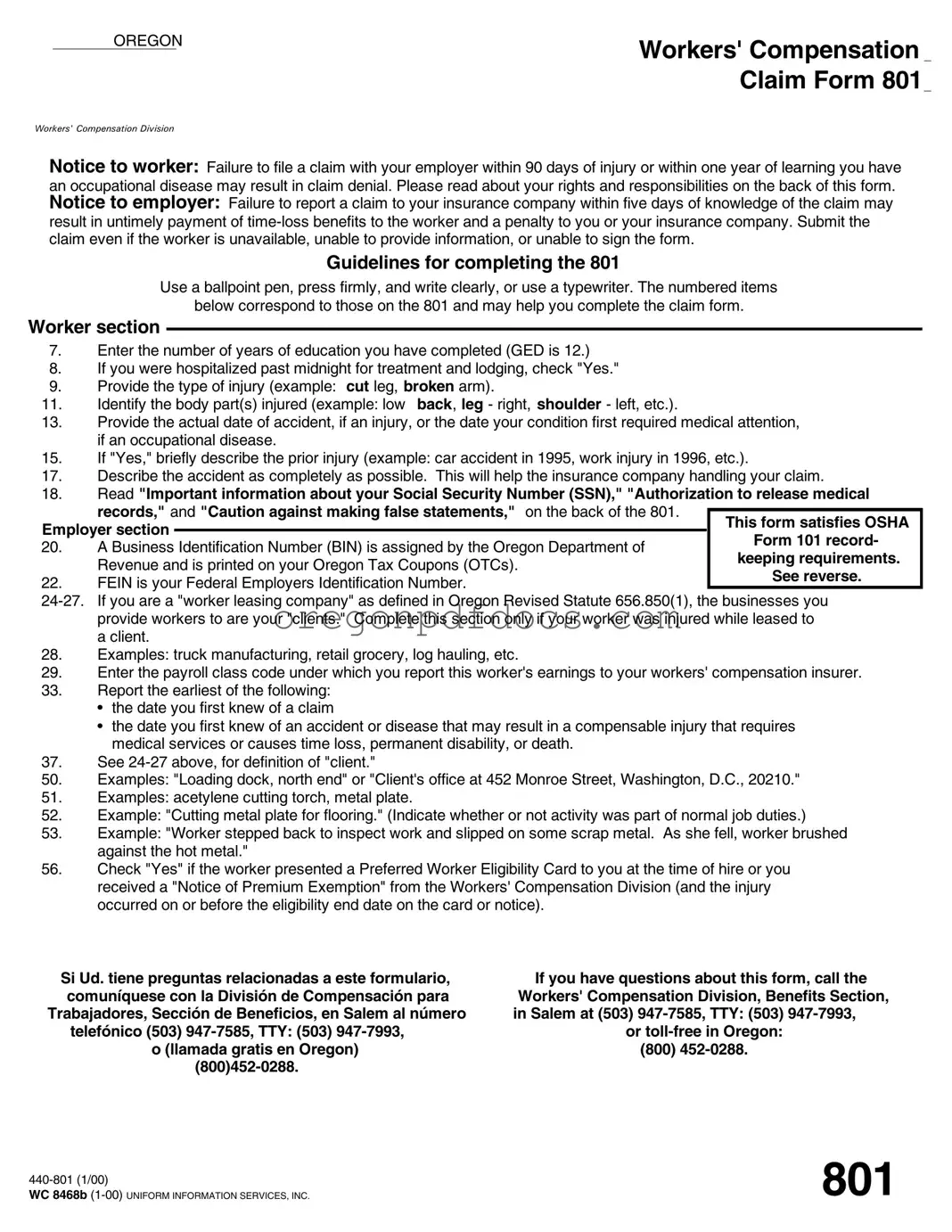
The Oregon Form 801 is a crucial document in the realm of workers' compensation, serving multiple functions for both employees and employers. This form fulfills the record-keeping requirements set forth by OSHA, specifically the OSHA Form 101. For workers, it is essential to file a claim within 90 days of an injury or within one year of discovering an occupational disease; failure to do so may result in denial of benefits. Employers, on the other hand, must report claims to their insurance company within five days of becoming aware of the incident to avoid penalties and delays in benefit payments. The form includes detailed sections for both workers and employers, requiring specific information such as the nature of the injury, dates of occurrence, and prior injuries. Workers are instructed to provide a thorough description of the accident, while employers must document their knowledge of the claim and the injured worker's details. Given the complexities involved in filing a claim and the potential consequences of errors or delays, understanding the Oregon Form 801 is imperative for both parties to ensure compliance and facilitate timely benefits.

Similar forms

  • Workers' Compensation Claim Form (California Form 1): Similar to the Oregon 801 form, this California form is also used to report workplace injuries and occupational diseases. Both forms require details about the injury, the worker's information, and employer responsibilities.

  • First Report of Injury (Florida Form DFS-F2-DWC-1): This form serves a similar purpose in Florida. It notifies the employer and insurance carrier about an employee's injury, ensuring timely processing of claims and benefits.

  • Employer's Report of Injury (Texas Form DWC-1): In Texas, this form is used to report workplace injuries. Like the Oregon 801, it requires information about the injured worker, the incident, and the employer's details.

  • Notice of Injury (New York Form C-3): This form is utilized in New York to report an injury. Both forms focus on the rights and responsibilities of workers and employers in the claims process.

  • Accident Report Form (Illinois Form 45): In Illinois, this form captures details about workplace accidents. It shares similarities with the Oregon 801 in terms of required information about the injury and the worker's background.

  • Workers' Compensation Claim Form (Washington Form F242-130-000): This form is used in Washington state to file a workers' compensation claim. Both forms require comprehensive details about the injury and the circumstances surrounding it.

  • Incident Report Form (Ohio BWC Form C-1): This Ohio form documents workplace injuries. It parallels the Oregon 801 by emphasizing the importance of timely reporting and accurate information for claims processing.

  • Claim for Compensation (Michigan Form WC-100): In Michigan, this form is used to file a claim for workers' compensation benefits. Like the Oregon 801, it requires detailed information about the injury and the worker's medical treatment.

  • Workers' Compensation Claim Form (Nevada Form C-3): This form is similar to the Oregon 801 as it collects information regarding workplace injuries and the responsibilities of both the worker and employer.

  • Report of Occupational Injury or Illness (Minnesota Form WC-1): In Minnesota, this form is used to report workplace injuries. It shares common elements with the Oregon 801, focusing on the injury details and the worker's personal information.
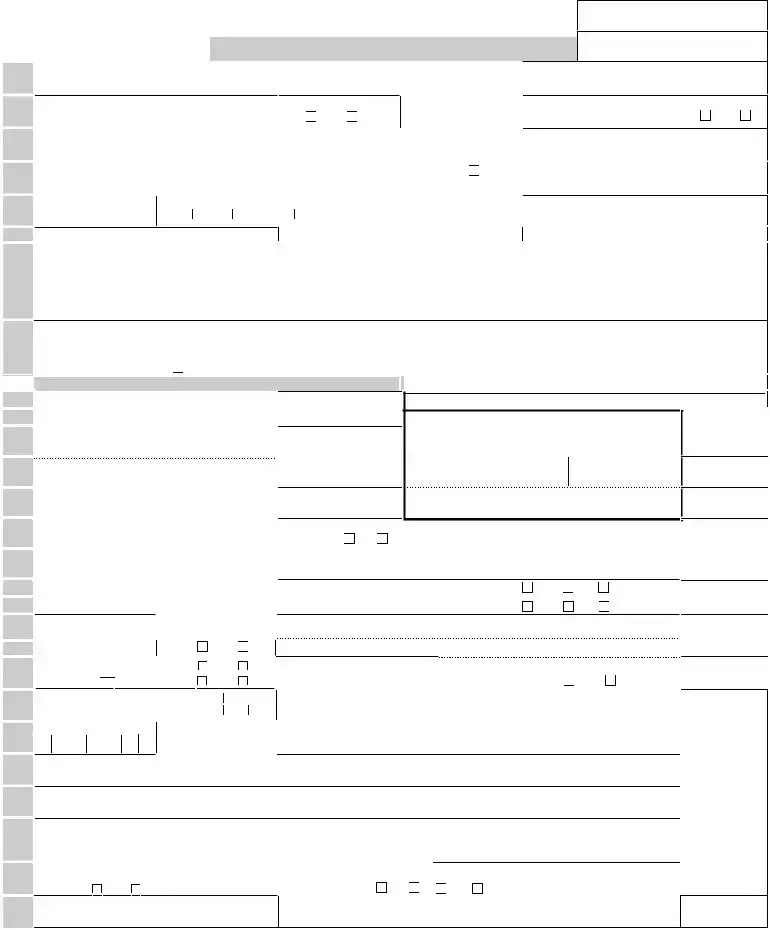
Preview - Oregon 801 Form

Insert self-insured employer and insurer name, address, phone number, and
service company, if any.
Report of Job Injury or Illness
Workers’ compensation claim
Worker
To make a claim for a work-related injury or illness, fill out the worker portion of this form and give it to your employer. If you do not intend to
file a workers’ compensation claim with the insurance company, do not sign the signature line. Your employer will give you a copy
.
Date of
injury or illness:
Date you
left work:
Time you began work
on day of injury:
a.m.
p.m.
Regularly scheduled
days off:
M T W T F S S
DEPT USE:
Time of injury
or illness:
a.m.
p.m.
Time you
left work:
a.m.
p.m.
Check here if you have more than one
job:
What is your illness or injury? What part of the body? Which side? (Example: Sprained right foot) Left Right
What caused it? What were you doing? Include vehicle, machinery, or tool used. (Example: Fell 10 feet when climbing an
extension ladder carrying a 40-pound box of roofing materials)
Information ABOVE this line; date of death, if death occurred; and Oregon OSHA case log number must be released to an authorized worker representative upon request.
Your legal name:
Language preference:
Birthdate:
Gender: M F
Your mailing address:
Home phone:
Work phone:
Occupation:
Names of witnesses:
Name and phone number of health insurance company:
Name and address of health care provider who treated you for the
injury or illness you are now reporting:
Were you hospitalized overnight? Yes No
Were you treated in the emergency room? Yes No
By my signature,
I am making a claim for workers’ compensation benefits. The above information is true to the best of my knowledge and belief. I
authorize health care providers and other custodians of claim records to release relevant medical records to the workers’ compensation insurer, self-insured
employer, claim administrator, and the Oregon Department of Consumer and Business Services.
Notice:
Relevant medical records include records of prior
treatment for the same conditions or of injuries to the same area of the body. A HIPAA authorization is not required (45 CFR 164.512(I)). Release of
HIV/AIDS records, certain drug and alcohol treatment records, and other records protected by state and federal law requires separate authorization.
I understand I have a right to see a health care provider of my choice subject to certain restrictions under ORS 656.260 and ORS 656.325.
Worker
signature:
Completed by
(please print):
Date:
Employer
Complete the rest of this form and give a copy of the form to the worker. Even if the worker does not want to file a claim, keep a copy of this form.
Employer legal
business name:
Phone:
FEIN:
If worker leasing company,
list client business name:
Client
FEIN:
Address of principal place
of business (not P.O. Box):
Insurance
policy no.:
Street address from which
worker is/was supervised:
ZIP:
Nature of business in which worker
is/was supervised:
Address where
event occurred:
Was injury caused by failure of a machine or product, or by a person other than the injured worker? Yes No
Were other workers injured? Yes No
OSHA 300 log case no:
Date employer
knew of claim:
Date worker
returned to work:
Worker’s
weekly wage: $
Date worker
hired:
If fatal, date
of death:
By my signature, I acknowledge I am responsible for notifying my workers’ compensation insurance company within five days of knowledge of the claim.
I
understand I may not restrict the worker’s choice of or access to a health care provider. If I do, it could result in civil penalties under ORS 656.260.
Employer
signature:
Name and title
(please print):
Date:
440-8
01 (1/21/DCBS/WCD/WEB)
OSHA requirements:
Employers must report work-related fatalities and catastrophes to Oregon OSHA either in person or
by telephone within eight hours. In addition, employers must report any in-patient hospitalization, loss of an eye, and any
amputation or avulsion that results in bone or cartilage loss to Oregon OSHA within 24 hours. See OAR 437-001-0704. Call
800-922-2689 (toll-free), 503-378-3272, or Oregon Emergency Response, 800-452-0311 (toll-free), on nights and weekends.
801

Key takeaways

  • File Promptly: You must submit your claim within 90 days of your injury or within one year of discovering an occupational disease. Delays can lead to claim denial.
  • Clear Information: Use a ballpoint pen or typewriter to fill out the form. Ensure your handwriting is clear and legible.
  • Details Matter: Provide specific information about your injury, including the body parts affected and a detailed description of the accident.
  • Education Level: Indicate the number of years of education completed. A GED counts as 12 years.
  • Employer's Responsibilities: Employers must report claims to their insurance company within five days of learning about the claim to avoid penalties.
  • Medical Records: By signing the form, you authorize medical providers to release relevant records related to your claim.
  • Time-Loss Benefits: Payments for lost wages begin only after your doctor notifies the insurer of your inability to work. There is a three-day waiting period for these benefits.
  • Keep Copies: Retain copies of all documents related to your claim, including the completed Form 801 and any correspondence from your employer or insurer.

File Details

Fact Name Description
OSHA Compliance The Oregon 801 form meets the record-keeping requirements set forth by OSHA Form 101.
Filing Deadlines Workers must file a claim with their employer within 90 days of injury or one year of learning about an occupational disease to avoid claim denial.
Employer Responsibilities Employers must report a claim to their insurance company within five days of becoming aware of the claim to ensure timely payment of benefits.
Education Requirement Workers must indicate their years of education completed on the form, with a GED counted as 12 years.
Governing Laws The form is governed by Oregon Revised Statute 656.265 and related administrative orders concerning workers' compensation.

Documents used along the form

The Oregon 801 form is an essential document for workers' compensation claims in Oregon. Alongside this form, several other documents are frequently utilized to ensure a comprehensive approach to filing a claim and managing the associated processes. Below is a list of seven important forms and documents that often accompany the Oregon 801 form, each serving a specific purpose in the claims process.

  • Form 827 - First Report of Injury/Disease: This form is typically completed by the injured worker's doctor and serves as the initial report to the insurer regarding the injury or disease. It includes details about the nature of the injury, the date it occurred, and the treatment provided.
  • Form 801A - Employer's Report of Occupational Injury or Disease: This document is filled out by the employer to provide their perspective on the incident. It includes information about the worker's job duties at the time of the injury and any witnesses to the event.
  • Form 440-3223 - Authorization for Release of Medical Records: This authorization allows medical providers to share the injured worker's medical records with the insurer. It is crucial for ensuring that the insurer has access to all necessary information for processing the claim.
  • Motorcycle Bill of Sale: The Forms Georgia provides essential resources for completing the Motorcycle Bill of Sale, ensuring all necessary details are accurately documented to facilitate a smooth transaction between buyer and seller.
  • Form 440-801 - Claim for Compensation: This is a more detailed form that may be required to accompany the 801 form, providing additional information about the worker's claim for compensation, including wage details and the extent of the injury.
  • Form 440-3220 - Notice of Claim: This form serves as a formal notice to the employer and the insurer that a claim has been filed. It outlines the worker's intent to seek benefits and is essential for tracking the claim's progress.
  • Form 440-801-1 - Claimant's Medical History: This document collects detailed medical history relevant to the injury or disease claimed. It helps the insurer understand any pre-existing conditions that may affect the claim.
  • Form 440-802 - Notice of Acceptance or Denial: Once the insurer has reviewed the claim, this form is issued to inform the worker of the decision regarding their claim. It outlines whether the claim has been accepted or denied and provides reasons for the decision.

Understanding these accompanying documents can significantly enhance a worker's ability to navigate the claims process effectively. Each document plays a vital role in ensuring that all necessary information is provided to support the claim, ultimately aiding in the timely processing of benefits. Being well-informed about these forms can empower injured workers to advocate for their rights and secure the benefits they deserve.